

In the hospitality sector, bedding is not a commodity—it is a strategic asset directly tied to guest satisfaction, brand perception, and operational efficiency. For procurement leaders and hotel operators, selecting the right bedding requires a structured evaluation framework that balances comfort, durability, compliance, and total cost of ownership (TCO).
This guide provides a comprehensive, B2B-focused analysis of hotel bedding selection, covering design standards, material performance, and lifecycle management.
Why Bedding Strategy Matters in Hospitality
Bedding plays a critical role in:
- Guest experience differentiation: Sleep quality is a top driver of reviews and repeat bookings
- Operational efficiency: Durable materials reduce replacement frequency and laundry costs
- Brand positioning: Premium bedding supports upscale and wellness-oriented branding
- Compliance & hygiene: Alignment with international safety and sanitation standards
A well-defined bedding strategy directly impacts RevPAR, occupancy rates, and long-term profitability.
Core Design Standards for Hotel Bedding
Comfort Engineering: Balancing Softness and Support
Hotel bedding must deliver a universally comfortable sleep experience across diverse guest profiles. Key design considerations include:
- Thread count optimization: Typically 200–400 TC for durability and breathability
- Weave type: Percale for crisp feel; sateen for smooth, luxurious texture
- Layering system: Mattress topper + duvet + pillows to create a “cloud-like” experience
Standardization across rooms ensures consistent brand delivery.
Size and Fit Standardization
Hotels must align bedding dimensions with mattress specifications to avoid operational inefficiencies:
- Fitted sheets with deep pockets (≥35 cm) for modern mattresses
- Oversized duvets for aesthetic drape and full coverage
- Pillow size consistency (standard vs. king) across room categories
This reduces housekeeping complexity and improves visual presentation.
Hygiene and Safety Compliance
Bedding must meet strict hygiene and safety requirements:
- OEKO-TEX® Standard 100 certification for chemical safety
- Antimicrobial treatments for high-turnover environments
- High-temperature wash resistance (≥60°C) for sanitation
Compliance is not optional—it is a baseline requirement for global hospitality operations.
Material Performance: Choosing the Right Fabrics
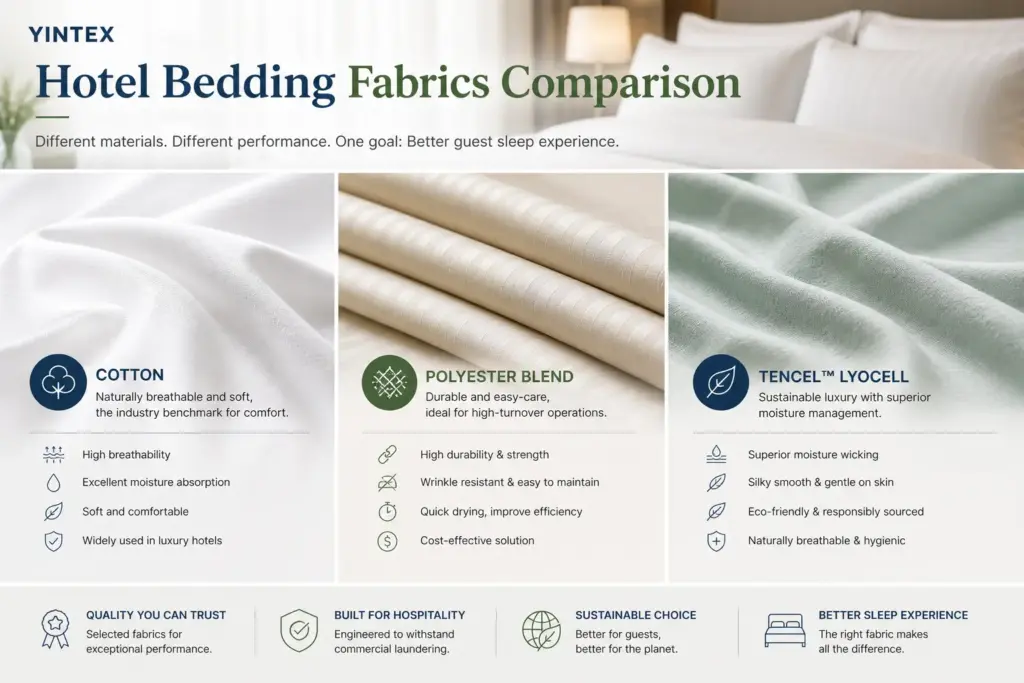
Cotton: The Industry Benchmark
Cotton remains the dominant material due to its balance of comfort, breathability, and cost-effectiveness.
Variants include:
- Combed cotton for enhanced softness
- Egyptian cotton for premium positioning
- Organic cotton for sustainability-focused brands
Performance profile:
- High breathability
- Good moisture absorption
- Moderate durability (with proper care)
Polyester and Blends: Durability and Cost Efficiency
Polyester-cotton blends are widely used in mid-scale and high-volume hotels.
Advantages:
- Wrinkle resistance reduces ironing costs
- Faster drying time improves laundry throughput
- Higher tensile strength extends lifespan
Typical blend ratios (e.g., 60/40 or 50/50) balance comfort and durability.
TENCEL™ and Advanced Fibers: Premium Differentiation
TENCEL™ (lyocell) and other regenerated fibers are increasingly adopted in upscale hotels.
Key benefits:
- Superior moisture management
- Silky texture enhances perceived luxury
- Eco-friendly production aligns with ESG goals
These materials support premium pricing strategies and brand storytelling.
Linen: Niche Luxury with Long Lifecycle
Linen is used in boutique and luxury properties for its natural aesthetic and durability.
Considerations:
- Longer lifespan than cotton
- Distinct texture (not universally preferred)
- Higher upfront investment
Best suited for brands emphasizing authenticity and eco-luxury positioning.
Durability and Lifecycle Management
Understanding Bedding Lifespan
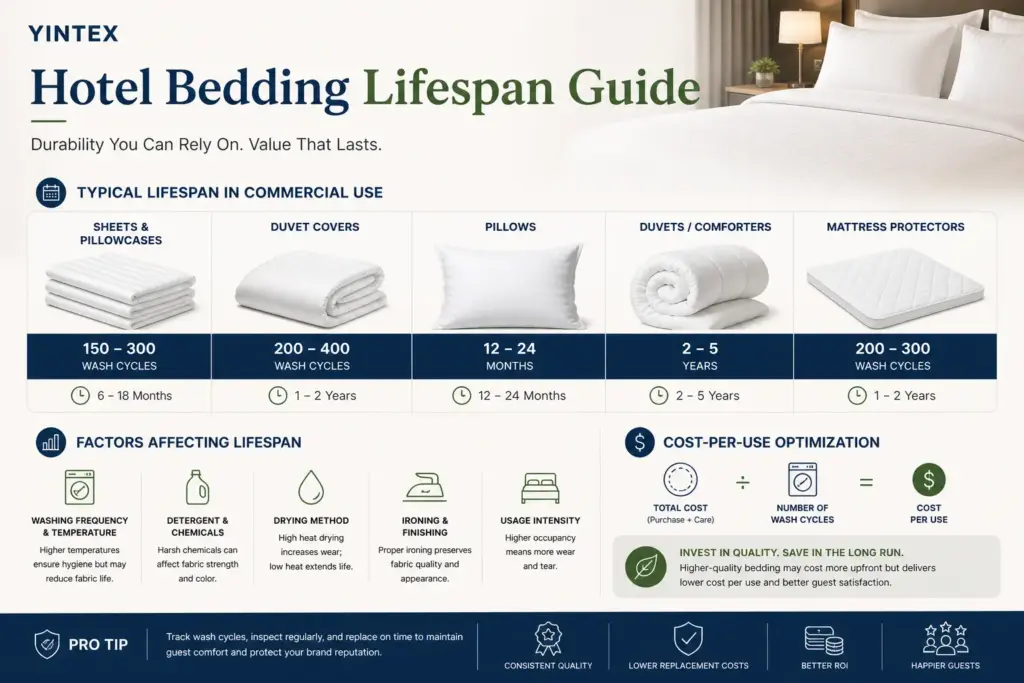
Typical lifecycle benchmarks:
- Sheets & pillowcases: 150–300 wash cycles
- Duvet covers: 200–400 wash cycles
- Pillows: 12–24 months
- Duvets: 2–5 years
Actual lifespan depends on material quality, laundering processes, and usage frequency.
Cost-per-Use Optimization
Procurement decisions should shift from unit price to cost-per-use:
Formula:
Cost per use = Total cost ÷ Number of wash cycles
Higher-quality products often deliver lower long-term costs despite higher initial investment.
Laundry and Maintenance Impact
Material selection directly affects operational costs:
- Cotton: Higher drying time → increased energy cost
- Polyester blends: Faster processing → improved efficiency
- High-quality fabrics: Reduced pilling and tearing → lower replacement rate
Aligning bedding with laundry infrastructure is critical for ROI optimization.
Sustainability as a Strategic Driver
Sustainability is becoming a procurement mandate in hospitality.
Key trends:
- Adoption of organic and recycled materials
- Reduction of water and energy consumption in laundering
- Supplier transparency and traceability
Certifications such as GOTS and OEKO-TEX® are increasingly required in RFP processes.
Yintex: Enabling Scalable Hotel Bedding Solutions
Yintex provides B2B bedding solutions tailored for hospitality clients, with a focus on:
- Customizable specifications (materials, sizes, branding)
- High-durability fabrics engineered for commercial laundering
- Sustainable material options aligned with global standards
- Stable supply chain and scalable production capacity
By integrating product engineering with operational insights, Yintex helps hotel partners optimize both guest experience and cost efficiency.
Conclusion: A Strategic Procurement Framework
Selecting hotel bedding is no longer a tactical decision—it is a cross-functional strategy involving procurement, operations, and brand management.
Key takeaways:
- Prioritize performance metrics over initial cost
- Align materials with brand positioning and guest expectations
- Optimize for lifecycle value and operational efficiency
- Integrate sustainability into core sourcing criteria
Hotels that adopt a data-driven, lifecycle-focused approach to bedding selection will gain a measurable competitive advantage in both guest satisfaction and financial performance.
 English
  Deutsch
  Español
  Français
  Português
  日本語
日本語  한국어
한국어  العربية
Leave a Reply